
On Sentimental Value and Bachelard

SPOILER ALERT : This essay discusses the entire plot of ‘Sentimental Value,’ right down to the final scene.
I’ve been haunted by a line from the philosopher Gaston Bachelard ever since I saw Joachim Trier’s new film. “The house we were born in,” he wrote, “is physically inscribed in us.” It’s an idea that’s hard to shake. A house it’s a set of “organic habits,” a history that gets written into your body.
I’m still trying to process Sentimental Value. It’s been a month since i watched it (i rewatched it yesterday), and I’m just left with this weight. A kind of emotional density. It’s an enormous film, but its immensity is all in its texture. It really does feel like a novel, a big, heavy one you live inside for a week. And I think that entire feeling, that weight, comes from this Bachelardian idea. The film understands, on a fundamental level, that the house is the physical archive of these character lives. It’s patient. It builds the family story with such meticulous care that by the end, the whole thing has expanded into this structure of incredible depth and density. Trier, along with his writing partner Eskil Vogt, has always been a master of modern anxiety. Their “Oslo Trilogy” was a brilliant chronicle of the crisis of becoming — of figuring out who to be, who to love, and what to do. For me Sentimental Value feels like a major shift. It is film about the crisis of being. It’s about what happens after someone already formed, when they have to turn around and face the past that built them.
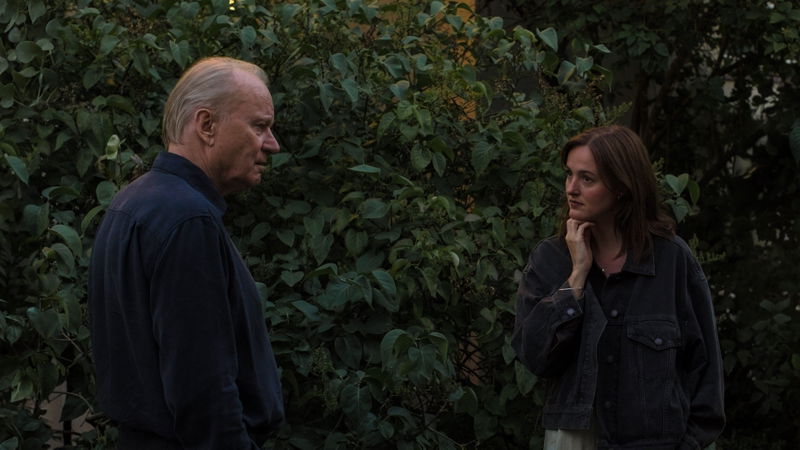
The film, which deservedly picked up the Grand Prix at Cannes, centers on a family that is practically suffocating on its own unarticulated past. Gustav, portrayed by Stellan Skarsgård, embodies the demanding artist and an emotionally absent father. He has spent a lifetime converting his family’s life into his art. And there is his two daughter: Agnes (Inga Ibsdotter Lilleaas) a historian who tries to understand the family’s past through a professional or rather an academic lens. And then there’s Nora, played by the astonishing Renate Reinsve, who tries to go through the same path as Gustav, art and performance.
Gustav, is what i called a man who is fundamentally inarticulate in life. He’s emotionally blocked in a way, and his art is the only language he has. And here is the incredible, agonizing, and deeply flawed crux of the film: he wants his daughter, Nora, to play in his film. In his mind, this is the only way he knows how to reach her, to bring her into his world. It’s an olive branch, but it’s an olive branch offered entirely on his own terms. He’s asking her to speak his language, and an attempt to try to inhabit his feeling, his trauma.
But for Nora — and Renate Reinsve is just vibrating with this, a completely raw nerve — this offer is an insult. She sees it as the ultimate act of selfishness. Why? Because he’s never even been to see her act. He’s never bothered to see her on stage, in her world, speaking her language. And now he’s asking her to perform for him? She, too, is a product of that house. But her inscribed history isn’t her grandmother’s; it’s the ghost of her parents’ toxic, unhappy marriage. Bachelard says the house is where “the values of intimacy are scattered… subjected to dialectics.” That’s Nora’s entire life. That house is the site of her childhood. It’s where she hid, where she listened to them fight, where her “values of intimacy” were scattered. It’s the place that’s physically also inscribed on her as much as to Gustav.
This is the film’s central conflict. The house is all “dialectics.” It’s inscribed with a father’s foundational trauma, a defining loss. But it’s also inscribed with a daughter’s childhood. These two histories are at war. They cannot co-exist in the same physical space.
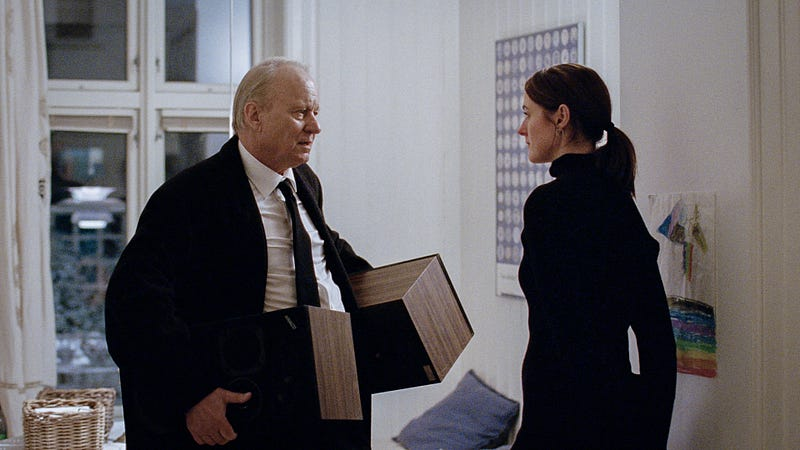
But what makes the film feel so novelistic is how Trier tells this story. The title is the key. It’s about the “sentimental value” we pour into objects and, spaces. This brings it all back to that opening idea. The film opens with this beautiful, haunting montage of the family home throughout generation. This sense of “texture” is built by the film’s formal choices. The story is broken into chapters, separated by jaring cuts to black — it’s a technique Trier has used before — effectively used again here.
This patient, accumulative rhythm is what gives the film its density. It allows tiny, almost throwaway moments to land with the force of a major plot point. There’s a scene where Nora and her father, separated by a chasm of resentment, share a quiet laugh over a cigarette. The film lets that moment breathe, giving it as much importance as any confrontational scene.
The resolution of this is also a profound rejection of the Bachelardian prison. The physical, “inscribed” house must be abandoned. It is too heavy, too full of competing ghosts. But in its place (in a way), a new house is built: a studio set. This is the film’s most brilliant move. This space is not an archive of involuntary memory; it is a shared, and controlled creation. It’s artifice. And it’s only here, in the “fake” house, the one they built together from Gustav script, that they can finally co-inhabit.
Comments
No comments yet. Be the first to comment!